A comprehensive geometry problems and solutions PDF serves as an essential resource for learners, offering detailed explanations and step-by-step guides for various geometric concepts. Ideal for students and educators, it provides a structured approach to mastering geometry through practice and visual aids.
- Covers foundational and advanced geometric principles.
- Includes diagrams and illustrations for clarity.
- Contains solved examples and exercises for self-practice.
1.1 Importance of Geometry in Mathematics
Geometry is a cornerstone of mathematics, providing foundational concepts like points, lines, and angles. It equips students with spatial reasoning and problem-solving skills, essential for advanced math and science. Geometry’s principles, such as theorems and proofs, enhance logical thinking and analytical abilities. Its applications in physics, engineering, and architecture highlight its real-world relevance. By studying geometry, learners develop a deeper understanding of shapes, structures, and their relationships, fostering creativity and critical thinking. These skills are vital for academic success and practical problem-solving in various fields.
1.2 Benefits of Using PDF Resources for Geometry Problems
PDF resources for geometry problems offer a structured and accessible way to learn and practice; They provide clear explanations, diagrams, and step-by-step solutions, making complex concepts easier to understand. PDFs are compatible with all devices, allowing anytime, anywhere access. Many resources include both problems and solutions, enabling self-study and immediate feedback; They often feature visual aids like graphs and illustrations, enhancing comprehension. Additionally, PDFs are easily shareable and printable, making them ideal for group study or classroom use. Their organized format ensures that learners can track progress and focus on areas needing improvement, fostering efficient and effective learning.
1.3 Overview of Popular Geometry Problem-Solving Books
Popular geometry problem-solving books offer comprehensive collections of exercises and detailed solutions. Titles like Geometry: 1001 Practice Problems For Dummies provide accessible practice for all skill levels. The Green Book of Mathematical Problems and The Red Book of Mathematical Problems are renowned for their challenging questions and clear explanations. Additionally, resources like NCERT Exemplar Problems and Solutions cater to students preparing for exams. These books often include hints, step-by-step solutions, and visual aids, making them invaluable for self-study and classroom use. They cover topics from basic geometry to advanced concepts, ensuring a thorough understanding of geometric principles.

Basic Geometry Problems and Solutions
Explore fundamental geometric concepts through simple problems and solutions. Topics include properties of triangles, circles, rectangles, and basic theorems. Visual aids enhance understanding of angles and lines.
- Properties of triangles, circles, and rectangles.
- Understanding angles and lines.
- Basic geometric theorems and proofs.
2.1 Solving Simple Geometric Shapes (Triangles, Circles, Rectangles)
Mastering basic geometric shapes is fundamental for building a strong foundation in geometry. Start by understanding the properties of triangles, circles, and rectangles. For triangles, calculate side lengths, angles, and area using formulas like Heron’s formula. Circles involve finding radii, diameters, and areas using π. Rectangles require calculating perimeters and areas. Practice problems often involve applying these formulas to real-world scenarios. Visual aids and step-by-step solutions in PDF resources help clarify complex calculations. Regular practice ensures proficiency in solving these shapes, forming the basis for more advanced geometric concepts.
- Calculate side lengths, angles, and areas of triangles.
- Determine properties of circles, such as radius and circumference.
- Apply formulas for rectangles, like perimeter and area.
2.2 Working with Angles and Lines
Understanding angles and lines is crucial in geometry. Learn to measure angles in degrees, identify types of angles (acute, obtuse, right), and explore properties of lines (parallel, perpendicular, intersecting). Practice problems often involve calculating unknown angles in triangles or proving line relationships. PDF resources provide clear solutions and diagrams to visualize these concepts. Mastering angles and lines lays the foundation for more complex geometric principles, enabling you to solve problems confidently.
- Measure angles and classify them by type.
- Analyze properties of parallel and perpendicular lines.
- Solve problems involving angle sums and line relationships.
2.3 Basic Theorems and Proofs in Geometry
Mastering basic theorems and proofs is essential for a strong geometry foundation. Key theorems include the Triangle Angle Sum Theorem, properties of parallel lines, and circle theorems. These concepts are supported by step-by-step proofs that clarify their validity. PDF resources often provide detailed explanations and visual aids to help students grasp these principles. Practicing proofs enhances logical reasoning and problem-solving skills, making it easier to tackle complex geometric problems with confidence;
- Understand fundamental theorems like the Triangle Angle Sum Theorem.
- Explore properties of lines and circles with proofs.
- Use visual aids to enhance comprehension of geometric principles.

Intermediate Geometry Problems and Solutions
This section delves into intermediate geometry concepts, offering problems and solutions on coordinate geometry, conic sections, and analytical methods. It bridges basic and advanced topics seamlessly.
- Covers equations of lines, circles, and conic sections.
- Incorporates practical exercises for skill enhancement.
- Uses visual aids to simplify complex geometric relationships.
3.1 Analytical Geometry: Equations of Lines and Circles
Analytical geometry focuses on solving problems using coordinate systems and algebraic methods. This section explores equations of lines and circles, essential for understanding geometric relationships. Equations of lines are represented in slope-intercept or standard form, while circles are defined by their center and radius. Solving systems of these equations helps determine intersections, distances, and tangents. Practical applications include calculating distances between points and finding the equations of tangent lines. The PDF resource provides detailed problems and solutions, along with visual aids, to enhance comprehension of these fundamental concepts.
- Covers equations of lines and circles in coordinate geometry.
- Includes solving systems of equations for intersections and distances.
- Provides practical exercises to strengthen problem-solving skills.
3.2 Properties of Conic Sections (Ellipses, Hyperbolas)
Conic sections, including ellipses and hyperbolas, are fundamental in analytical geometry. Ellipses are defined by their major and minor axes, while hyperbolas are characterized by their foci and asymptotes. The standard equations for ellipses and hyperbolas are derived from these properties. Problems involve finding foci, directrices, and eccentricity, as well as solving systems involving conic sections. The PDF resource provides exercises and solutions to master these concepts, ensuring a deep understanding of their geometric and algebraic relationships.
- Explores properties and equations of ellipses and hyperbolas.
- Includes exercises on foci, directrices, and eccentricity.
- Enhances problem-solving skills with detailed solutions.
3.3 Solving Geometric Problems Using Coordinate Geometry
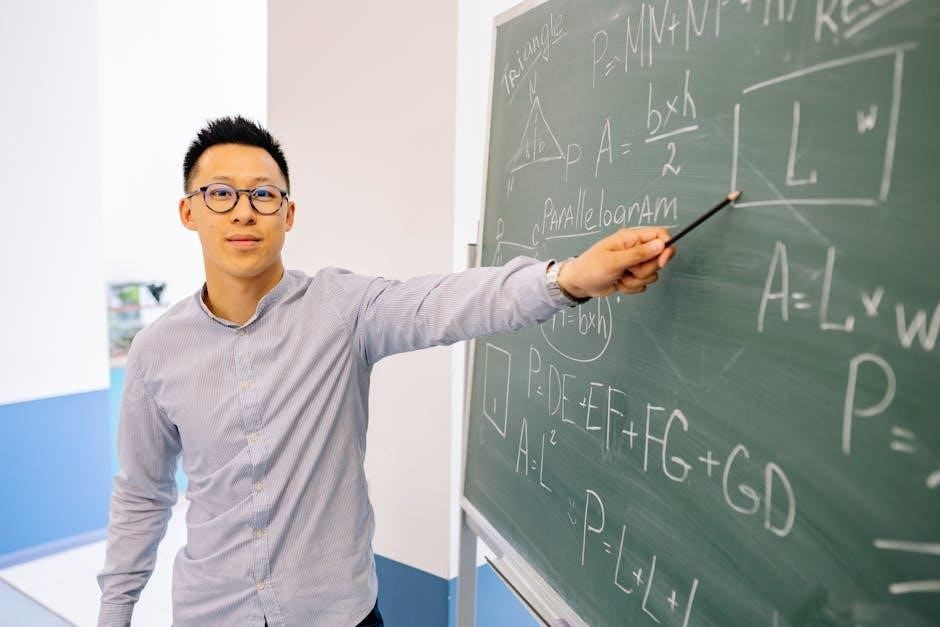
Coordinate geometry bridges algebra and geometry by using coordinate systems to solve problems. Key concepts include points, lines, slopes, distances, and equations of circles and hyperbolas. The PDF resource offers solved examples, demonstrating how to find distances between points, calculate slopes, determine line equations, and solve systems involving conic sections. Detailed solutions enhance understanding and problem-solving skills, making it easier to tackle complex geometric challenges.
Advanced Geometry Problems and Solutions
Advanced geometry involves complex concepts like differential geometry, curves, and surfaces. PDF resources provide solved examples, detailed solutions, and insights into complex geometric constructions and theorems.
4.1 Differential Geometry: Curves and Surfaces
Differential geometry explores the properties of curves and surfaces using calculus. It examines curvature, torsion, and geodesics, providing insights into complex shapes. PDF resources offer solved problems on curve and surface analysis, including conic sections and elliptic geometries. These solutions demonstrate advanced techniques for solving differential equations related to geometric constructions. Practical applications in physics and engineering highlight the importance of mastering these concepts. The PDFs include detailed proofs and visual aids, making them invaluable for deepening understanding of differential geometry.
4.2 Solving Complex Geometric Constructions
Solving complex geometric constructions involves advanced techniques for creating precise shapes and figures. PDF resources provide detailed solutions to intricate problems, such as Apollonius’ problem of constructing circles tangent to three given circles. These resources offer step-by-step guides, diagrams, and proofs to tackle challenging constructions. They cover topics like triangle construction, polygon circumscription, and conic section properties. By leveraging these materials, learners can master the logical reasoning and precision required for complex geometric constructions, enhancing their problem-solving skills in both theoretical and applied geometry.
4.3 Advanced Theorems in Euclidean Geometry
Advanced theorems in Euclidean geometry explore profound concepts like the Nine-Point Circle, Helly’s Theorem, and the Erdos-Nagy Theorem. These theorems delve into the properties of circles, convex sets, and rigid motions, respectively. PDF resources provide detailed proofs, applications, and solutions to problems involving these theorems. They enable learners to explore the depth of Euclidean geometry, connecting theoretical foundations to practical problem-solving. These resources are invaluable for understanding complex geometric relationships and their implications in various fields, making them essential for advanced geometry studies.

Geometry Problem-Solving Strategies
Effective geometry problem-solving involves analyzing examples, practicing exercises, and using visual aids. Resources with solved problems and hints guide learners in mastering geometric concepts efficiently.
5.1 Tips for Approaching Geometry Problems
Mastering geometry requires a systematic approach. Start by understanding the problem statement thoroughly. Sketch diagrams to visualize shapes and relationships. Break complex problems into simpler parts and use known theorems or properties. Practice regularly to build problem-solving intuition. Utilize resources like geometry problems and solutions PDFs for guided learning. Review mistakes to identify common errors and improve. Apply logical reasoning and coordinate geometry techniques when applicable. Seek hints or solutions in study materials to deepen understanding. Persistent practice and analytical thinking are key to excelling in geometry.
5.2 Common Mistakes to Avoid in Geometry
Common errors in geometry often stem from misapplying theorems or miscalculating measurements. Ensure accurate diagram sketches and label all points correctly. Avoid assuming properties without verification. Misunderstanding congruent and similar shapes can lead to incorrect conclusions. Always check unit consistency and avoid mixing units. Be cautious with negative lengths or areas. In coordinate geometry, verify axis placements and scale. Rushing through proofs without logical steps is a frequent mistake. Regularly reviewing problems and seeking solutions in geometry resources can help identify and correct these errors, improving overall problem-solving skills.
5.3 Using Visual Aids for Better Understanding
Visual aids are indispensable in geometry, helping students grasp complex concepts visually. Tools like diagrams, graphs, and sketches clarify spatial relationships, making abstract ideas tangible. Platforms such as Geometers Sketchpad enable interactive exploration, while graphing calculators and online simulators provide dynamic visualizations. Incorporating images and videos enhances comprehension, especially for 3D shapes and transformations. Highlighting key elements in diagrams ensures focus on critical details. Regular use of visual aids fosters a deeper understanding, simplifies problem-solving, and builds confidence in tackling geometric challenges.

Geometry Problems and Solutions in PDF Format
Access key geometry problems and solutions PDFs, including NCERT Exemplar and practice books, available on official websites for easy download.
6.1 Free Online Resources for Geometry Problems
Discover a wealth of free online resources offering geometry problems and solutions in PDF format. Websites like NCERT Exemplar provide chapter-wise solutions, while platforms like Geometry: 1001 Practice Problems For Dummies offer comprehensive practice materials. Additionally, resources such as The Green Book of Mathematical Problems and The Red Book of Mathematical Problems are available for download, covering analytic geometry, conic sections, and differential geometry. These resources cater to all skill levels, from basic to advanced, ensuring learners can practice and master geometry concepts effectively. Many also include visual aids and step-by-step solutions for better understanding.
6.2 Popular Geometry Problem Books with Solutions
Several widely recognized geometry problem books with solutions are available in PDF format, offering extensive practice for learners. Titles like Geometry: 1001 Practice Problems For Dummies and Challenging Problems in Geometry provide comprehensive collections of problems, complete with detailed solutions and hints. These books are organized by difficulty, covering basic shapes, analytical geometry, and advanced theorems. Many include visual aids and step-by-step explanations, making them ideal for self-study or classroom use. Additionally, books like The Green Book of Mathematical Problems and The Red Book of Mathematical Problems are popular for their diverse range of geometry exercises and solutions.
6.3 NCERT Exemplar Problems and Solutions for Class 12
The NCERT Exemplar Problems and Solutions for Class 12 Mathematics is a valuable resource for students preparing for exams. It covers key chapters like Three Dimensional Geometry and Conic Sections, offering a wide range of problems with detailed solutions. The PDF format allows easy access, and the structured approach aligns with the CBSE syllabus. These exemplar problems are designed to enhance understanding and problem-solving skills, making them an essential tool for students aiming to excel in geometry and related topics.
Applications of Geometry in Real Life
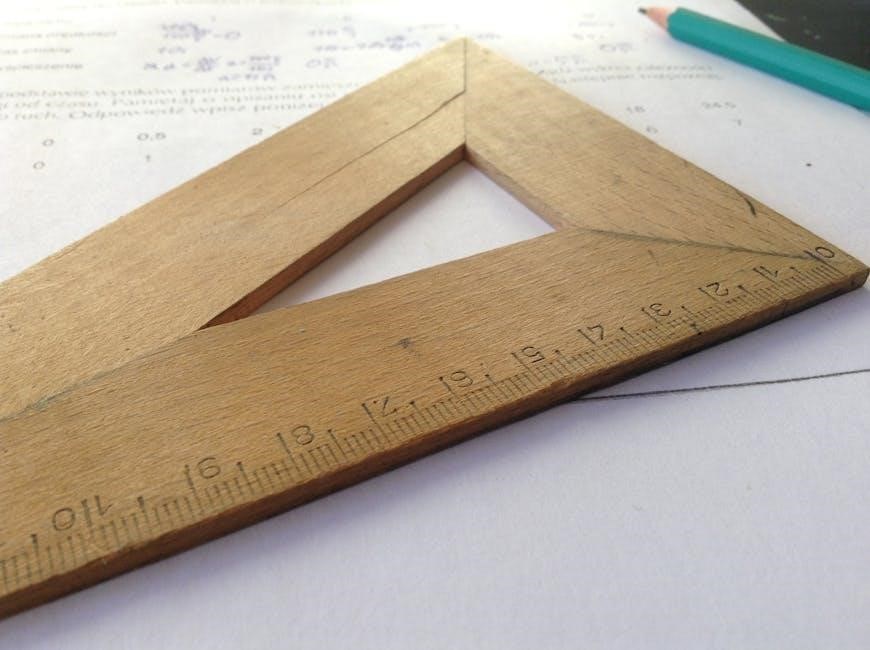
Geometry plays a vital role in architecture, engineering, physics, and astronomy. It aids in designing structures, calculating distances, and understanding spatial relationships, making it indispensable in everyday life.
- Architecture and construction rely on geometric principles for blueprinting.
- Physics uses geometry to model motion and forces.
- Astronomy applies geometry to map celestial bodies and their movements.
7.1 Geometry in Architecture and Engineering
Geometry is fundamental in architecture and engineering, enabling the creation of stable and aesthetically pleasing structures. From pyramids to modern skyscrapers, geometric principles like symmetry, proportions, and angles ensure durability and visual appeal. Engineers use geometric calculations to design bridges, tunnels, and machinery, ensuring safety and efficiency. In architecture, shapes like triangles, circles, and rectangles are combined to achieve both functionality and beauty. PDF resources and problem-solving guides provide essential tools for professionals and students to master these applications, bridging theoretical knowledge with practical implementation.
7.2 Geometric Principles in Physics and Astronomy
Geometric principles are integral to understanding phenomena in physics and astronomy. Concepts like circles, ellipses, and hyperbolas describe planetary orbits and gravitational fields. Analytic geometry aids in calculating trajectories and velocities, while spatial reasoning solves problems in relativity and quantum mechanics. PDF resources provide detailed solutions to problems involving geometric wave patterns and cosmic structures, bridging abstract theories with practical applications. These tools are essential for students and researchers, offering clear explanations and visual aids to master complex geometric applications in physics and astronomy.
7.3 Practical Uses of Geometry in Everyday Life
Geometry has numerous practical applications in daily life, from construction to navigation. Architects use geometric principles to design buildings, while engineers rely on spatial reasoning for infrastructure projects. Artists and designers apply geometric shapes for symmetry and balance. Even everyday tasks, like measuring rooms or plotting routes, involve geometric concepts. PDF resources offer solutions to real-life geometry problems, making them invaluable tools for professionals and hobbyists alike. Understanding geometry enhances problem-solving skills and fosters creativity, showing how this ancient science remains relevant in modern life.
- Construction and architecture
- Navigation and mapping
- Art and design
- Land surveying

Interactive Geometry Tools and Software
Interactive geometry tools like Geometer’s Sketchpad and graphing calculators enable dynamic problem-solving, enhancing visual understanding and engagement with geometric concepts through real-time simulations and constructions.
- Geometer’s Sketchpad
- Graphing calculators
- Online platforms
8.1 Geometers Sketchpad for Visualizing Geometry Problems
Geometers Sketchpad is a dynamic tool that transforms geometry learning by enabling interactive constructions and real-time problem visualization. It allows users to explore geometric relationships, manipulate shapes, and test hypotheses. With Sketchpad, students can create precise diagrams, measure angles and lengths, and animate geometric transformations. This software fosters deeper understanding by making abstract concepts tangible and engaging. It supports problem-solving by allowing users to experiment and observe outcomes instantly, making it an invaluable resource for both students and educators seeking to enhance their grasp of geometry.
- Interactive diagram creation
- Real-time modifications
- Exploration of geometric properties
8.2 Using Graphing Calculators for Geometry Solutions
Graphing calculators are powerful tools for solving geometry problems by enabling the visualization of equations and their geometric interpretations. They allow users to plot lines, circles, and conic sections, making it easier to analyze intersections and relationships. These calculators also support solving systems of equations, finding distances, and exploring transformations. Their ability to graph complex shapes and functions helps in understanding spatial relationships and verifying solutions. Additionally, graphing calculators facilitate interactive learning, enabling students to experiment with different scenarios and observe the outcomes, enhancing their problem-solving skills in geometry.
- Visualization of geometric equations
- Exploration of spatial relationships
- Interactive problem-solving
8.3 Online Platforms for Solving Geometry Problems
Online platforms offer interactive tools and resources for solving geometry problems, enhancing learning and problem-solving skills. Websites like GeoGebra provide dynamic geometry software for creating and exploring geometric figures. Khan Academy and Wolfram Alpha offer step-by-step solutions and visual aids for understanding complex geometric concepts. Additionally, online forums and communities allow students to discuss and resolve geometry-related queries. These platforms cater to diverse learning needs, making geometry more accessible and engaging for students of all levels.
- Interactive geometry tools like GeoGebra
- Step-by-step solutions on Wolfram Alpha
- Engaging resources on Khan Academy

Geometry Problem-solving Competitions
Geometry problem-solving competitions challenge participants to apply geometric concepts creatively and critically. These contests stimulate critical thinking and foster a deeper understanding of spatial relationships and theorems.
- Enhance problem-solving skills through competitive challenges.
- Encourage creative approaches to geometric problems.
- Build confidence in applying geometric principles effectively.
9.1 Preparing for Geometry Competitions
Preparing for geometry competitions requires a strategic approach to master problem-solving skills. Start with foundational concepts, gradually progressing to complex problems. Utilize practice books like “Geometry: 1001 Practice Problems For Dummies” and online resources offering hundreds of problems with solutions. Focus on understanding key theorems and visualizing geometric shapes. Regularly solve past competition papers to familiarize yourself with question patterns. Dedicate time to sketching diagrams and practicing proofs. Join study groups or online forums for collaborative learning. Most importantly, maintain consistency in practice to build confidence and problem-solving efficiency.
- Master foundational concepts first.
- Practice with diverse problem types.
- Use visual aids for better understanding.
- Review and analyze past competition papers.
9.2 Famous Geometry Problems from Mathematical Olympiads
Famous geometry problems from mathematical Olympiads often involve intricate constructions and elegant proofs. One such problem is the “Apollonius Problem,” which requires constructing circles tangent to three given objects. Another classic problem involves proving that the sum of the angles in a triangle is 180 degrees using geometric principles. These problems showcase advanced techniques and creative thinking, making them iconic in competitive mathematics. They are frequently featured in resources like “Challenging Problems in Geometry” and “The Green Book of Mathematical Problems,” providing students with opportunities to refine their skills.
- Apollonius Problem: Constructing tangent circles.
- Angle sum theorem: Proving triangle angle properties.
- Featured in renowned problem-solving books.
9.3 Strategies for Winning Geometry Competitions
To excel in geometry competitions, mastering problem-solving techniques is crucial. Focus on understanding geometric principles deeply, as this enables rapid identification of solutions. Practice with high-quality resources, such as “Challenging Problems in Geometry,” to refine skills. Time management is key; prioritize problems based on difficulty. Use visual aids like sketches to clarify complex scenarios. Additionally, analyze past mistakes to avoid repeating them. Staying calm under pressure and systematically breaking down problems can significantly improve performance. Regular practice with diverse problem types ensures versatility and confidence.
- Master geometric principles for quick solutions.
- Use visual aids to simplify complex problems.
- Analyze errors to improve future performance.
This PDF is an essential resource, guiding learners through geometry’s fundamentals to advanced concepts. It aids in mastering problem-solving techniques and applying them practically.
Regular practice and dedication are key to excelling in geometry, fostering a deeper appreciation for its role in shaping problem-solving skills.
10.1 Recap of Key Geometry Concepts
The PDF resource effectively summarizes essential geometry concepts, from basic shapes like triangles and circles to advanced topics such as conic sections and differential geometry. It emphasizes the importance of understanding angles, lines, and theorems, providing clear explanations and practical examples. The material also highlights analytical geometry, coordinate systems, and geometric constructions, ensuring a comprehensive understanding. By revisiting these key concepts, learners can solidify their foundation and approach complex problems with confidence.
- Covers fundamental principles and advanced theories.
- Includes visual aids for better comprehension.
- Offers practical applications of geometric concepts.
10.2 Encouragement to Practice Geometry Regularly

Regular practice is crucial for mastering geometry, as it enhances problem-solving skills and spatial reasoning. Consistent effort helps build confidence and familiarity with geometric principles. Utilize the provided PDF resources, which include exercises and solutions, to reinforce learning. Dedicate time daily to solve problems, starting with basic concepts and gradually progressing to complex ones. This disciplined approach ensures long-term retention and improved performance in exams or real-world applications. Embrace challenges and view mistakes as opportunities to learn and grow.
- Consistency strengthens problem-solving abilities.
- Practice fosters a deeper understanding of geometric concepts.
- Regular effort leads to improved academic and practical outcomes.
10.3 Final Thoughts on the Importance of Geometry
Geometry is a cornerstone of mathematics, offering invaluable insights into spatial reasoning and problem-solving. Its applications span architecture, engineering, physics, and everyday life, making it an essential skill. The structured approach of geometry problems and solutions PDFs provides a clear path to mastery, fostering logical thinking and creativity. By embracing geometry, learners gain a deeper understanding of the world and develop skills that are both academically and practically rewarding. Continued exploration and practice will unlock its full potential, ensuring lasting benefits in various fields of study and real-world applications.
- Geometry enhances spatial awareness and analytical skills.
- Its principles are foundational to numerous scientific disciplines.
- Regular practice with PDF resources ensures lifelong mastery.
Leave a Reply
You must be logged in to post a comment.